Quick Guide
Let's be honest. We've all been there. You've got those thin chicken breasts staring at you from the cutting board, and that nagging question pops up: how long do I actually cook these things? Too little time, and you're playing a dangerous game with food safety. Too much, and you're left with a sad, dry, chewy piece of cardboard that's a chore to eat. I've ruined my fair share, believe me. Once, I turned what should have been a quick weeknight dinner into a jaw-exercising session because I got distracted and left them in the pan for just a few minutes too long.
The frustration is real. Recipes are everywhere, but they often assume you have a plump, even, 8-ounce breast. Reality? You're dealing with uneven, sometimes comically thin cuts from the grocery store, or you've pounded them yourself into submission for a recipe. The standard cooking times just don't apply.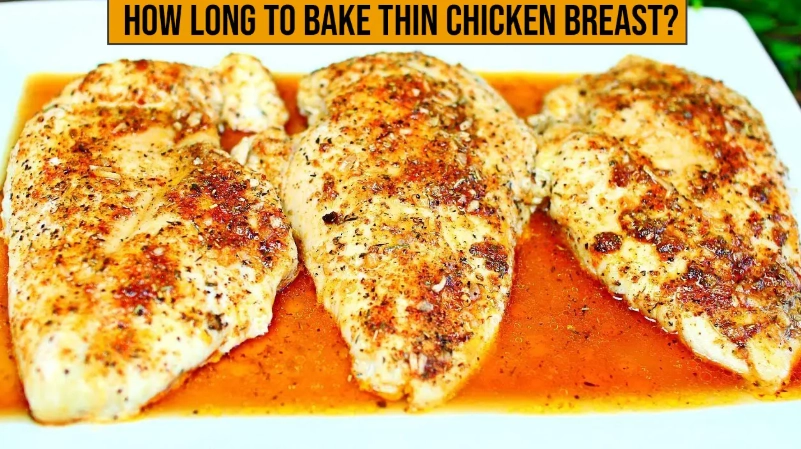
So, let's cut through the noise. This isn't about fancy techniques or chef secrets. It's about getting a simple, juicy, safely cooked thin chicken breast on your plate, consistently. Whether you're pan-searing, baking, or grilling, the core principle is understanding that thin chicken breast cooking time is measured in minutes, not tens of minutes. The window between perfect and overdone is incredibly small.
Why Getting the Time Right for Thin Cuts is a Different Game
You can't just take a time for a thick breast and halve it. The physics of heat transfer changes completely. A thick breast allows for a nice sear on the outside while the gentle, residual heat slowly brings the inside to temperature. It's forgiving.
A thin breast has no such buffer. High heat hits it, and penetrates right through to the center almost immediately. There's no time for a gradual cook. This is why the number one enemy of thin chicken breast is high heat for too long. You blast it on high for 4 minutes a side, and the outside is leather before the inside is even close to done. Or worse, the outside looks perfect but the inside is still translucent.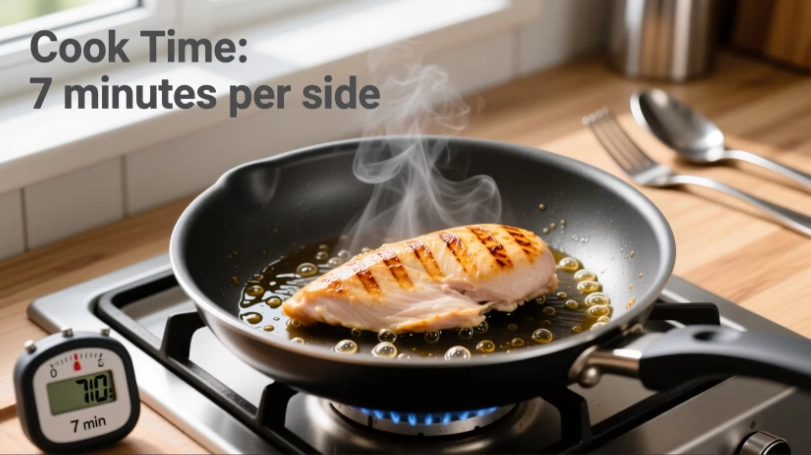
My personal lightbulb moment came when I stopped treating them like their thicker cousins. I had to shift my mindset from "cooking chicken" to "quickly searing a thin protein." The goal is maximum browning in the shortest possible time, followed by either a very brief rest or a gentle finish.
The Non-Negotiable: Safe Internal Temperature
Before we talk about methods and minutes, we have to talk safety. Time is a guideline; temperature is the law. The USDA Food Safety and Inspection Service states clearly that all poultry, including chicken breast, should be cooked to a minimum safe internal temperature of 165°F (74°C). You can read their official guidelines here on their safe temperature chart.
Now, with safety front and center, let's break down exactly how long to cook thin chicken breast using the most common methods.
Method-by-Method Thin Chicken Breast Cooking Time
Here’s where we get practical. I've put together a table that lays it all out. Remember, these times are for boneless, skinless chicken breasts that are about 1/2 inch thick. If yours are thinner (1/4 inch) or a bit thicker (3/4 inch), you'll need to adjust.
| Cooking Method | Approx. Time per Side (or Total) | Key Temperature / Visual Cue | Best For |
|---|---|---|---|
| Pan-Searing (Stovetop) | 3-4 minutes per side | Internal 165°F; golden-brown crust | Quickest method, great sear, weeknights |
| Baking (Oven) | 12-18 minutes total | Internal 165°F; juices run clear | Hands-off, cooking multiple pieces, even cooking |
| Grilling (Outdoor) | 3-5 minutes per side | Internal 165°F; distinct grill marks | Smoky flavor, summer meals, meal prep |
| Air Frying | 8-12 minutes total | Internal 165°F; crispy exterior | Oil-free/crispy texture, fast, small batches |
| Poaching | 8-10 minutes total (simmering) | Internal 165°F; opaque throughout | Ultra-moist, shredding for salads/soups |
See how short those times are? This is the critical takeaway. Set a timer. Don't walk away to check your phone.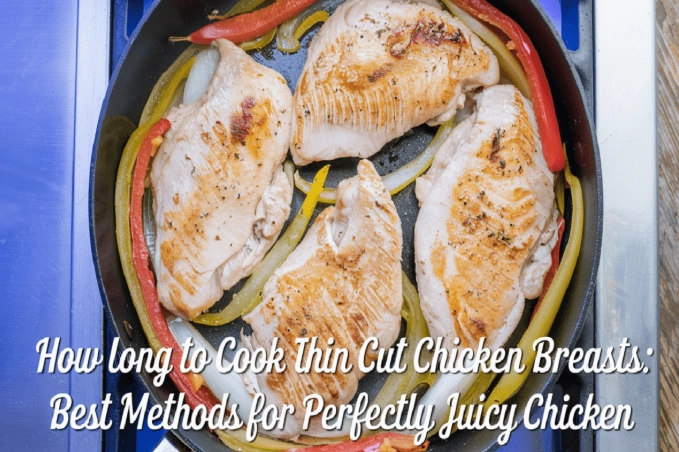
Deep Dive: Pan-Searing – The Weeknight Champion
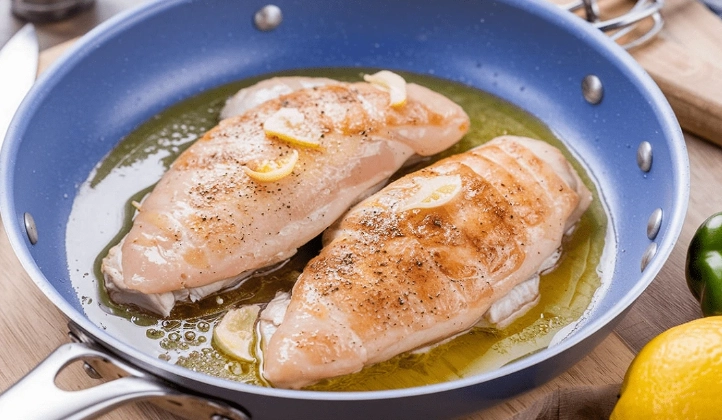
This is my go-to method 90% of the time. It's fast, creates fantastic flavor from the browned bits (fond) in the pan, and gives you the most control. Here's my step-by-step, born from both success and failure.
First, pat those breasts bone dry with paper towels. Moisture is the enemy of browning. Season generously. While your pan (I prefer stainless steel or cast iron for a good sear) heats up over medium-high heat, let the chicken sit out for 10 minutes to take the chill off. A cold chicken hit a hot pan will steam and stick.
Add a high-smoke-point oil—avocado or grapeseed are great. When the oil shimmers, lay the chicken in the pan. Don't crowd it. You should hear an immediate sizzle. Now, the hardest part: leave it alone. Don't poke, don't prod. Let it form that crust for a full 3 minutes.
Peek at the edges. If they look opaque about halfway up the side, it's time to flip. Use tongs, flip confidently. The second side usually cooks a tiny bit faster, maybe 2.5 to 3.5 minutes. This is when you check the temperature. Slide your instant-read thermometer into the side. If it's at or near 160°F, get it out of the pan and onto a plate.
That's it. From start to finish, you're looking at about 15 minutes for perfect how to cook thin chicken breast on the stove. The whole process hinges on managing high heat for a very short, precise duration.
Baking: The Set-It-and-Forget-It Approach
Baking is fantastic when you have a few pieces to cook evenly, or you want to add other ingredients to the sheet pan. The key here is high heat again, but with the gentle, surrounding warmth of the oven.
Preheat your oven to 425°F (220°C). This high temp helps mimic the sear of a pan. Place your seasoned chicken breasts on a parchment-lined baking sheet. For even more insurance against dryness, you can bake them on a bed of sliced onions, lemon rounds, or even a rack. I sometimes brush them lightly with mayo or olive oil—it sounds weird, but mayo is just oil and egg, and it creates an incredible golden, moist barrier.
Slide the sheet into the hot oven. Set a timer for 10 minutes. At the 10-minute mark, start checking the temperature. For most 1/2-inch cuts, they'll be done between 12 and 15 minutes. I've had some super thin ones hit temp at 10 minutes flat. This is why the thermometer is your best friend for boneless skinless chicken breast cooking time in the oven.
Take them out, let them rest, and you've got perfectly hands-off chicken for salads, bowls, or slicing for sandwiches.
Beyond the Clock: Factors That Change Cooking Time
So you followed the 4-minute rule and it was still dry. What gives? Time is the main lever, but these other factors play a huge role.
- Thickness (The Big One): This is obvious but critical. A 1/4-inch cut might cook in 90 seconds per side. A 3/4-inch cut might need 5-6. If your package has wildly varying thicknesses, consider pounding them to an even level with a meat mallet or the bottom of a heavy pan. It makes timing predictable.
- Starting Temperature: I mentioned this briefly. A fridge-cold (35°F) breast will take noticeably longer to cook through than one that's sat at room temp for 15 minutes (55-60°F). That extra few minutes on the counter trying to warm the core can mean the outside overcooks.
- Your Pan and Stove: My medium-high might be your high. An electric coil stove heats differently than gas or induction. A thin, warped pan will have hot spots that burn one part of the chicken while the rest is raw. Learn your equipment. If things are browning too fast, don't be afraid to lower the heat.
- To Pound or Not to Pound: Pounding ensures even thickness, which is the holy grail for consistent thin chicken breast cooking time. But it also breaks down muscle fibers, which can make the meat slightly less chewy but also can make it easier to overcook if you're not careful. It's a trade-off. For cutlets (like for chicken piccata), pounding is essential. For simple searing, it's a great insurance policy.
Think of the time guides as your home base. You adjust from there based on these real-world conditions.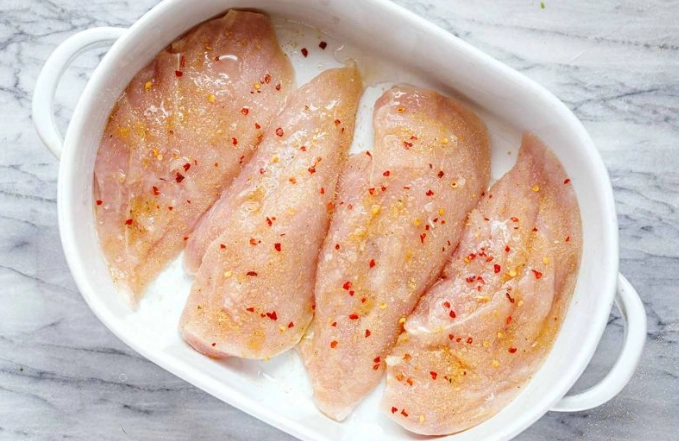
Answers to Your Burning Questions (FAQs)
How do I know when thin chicken breast is done without a thermometer?
I'm going to be a bit of a safety nag here: you should really use a thermometer. It's the only sure way. But if you absolutely must go without, use the "touch test" and visual cues together. Press the center of the breast with your finger. If it feels firm with a slight spring back (like the fleshy part of your palm below your thumb when you touch your thumb and pinky together), it's likely done. Also, pierce the thickest part with a fork or knife. The juices should run completely clear, not pink or cloudy. The meat should be opaque all the way through when you cut into it (but by then, it's too late to save it if it's overdone). This method is risky, especially with thin cuts where the margin for error is tiny.
Should I cover the pan when cooking thin chicken breast?
Generally, no. Covering creates steam, which softens the beautiful crust you're trying to build when pan-searing. However, there's one exception: if you've seared both sides beautifully and the temperature is still a bit low (say, 150°F), you can add a splash of broth or wine to the pan, cover it, and let it steam for 60-90 seconds. This gently finishes the cooking without further browning. It's a handy rescue technique.
How long to cook thin chicken breast from frozen?
This is a whole different beast, and honestly, I don't recommend it for thin cuts. The outside will be dry and tough long before the icy center thaws and cooks. If you must, the safest method is to thaw it first in the fridge, in cold water, or in the microwave using the defrost setting. If cooking from frozen is your only option, bake it in a 375°F oven. It will take 25-35 minutes, and the texture will suffer. Plan ahead if you can.
Why is my thin chicken breast always tough and rubbery?
Overcooking. Full stop. Chicken breast muscle fibers are delicate. When they are heated past their ideal doneness (around 165°F), they squeeze out all their moisture and contract tightly, resulting in that tough, rubbery, stringy texture. Thin breasts hit this point in the blink of an eye. The solution is lower heat, shorter time, and pulling it at the right temperature.
What's the best way to reheat thin chicken breast so it's not dry?
Reheating is almost harder than cooking it the first time. The microwave is the worst offender—it turns it into rubber. The best method is gentle, moist heat. Slice it and briefly warm it in a pan with a bit of sauce, broth, or even a sprinkle of water covered with a lid for just a minute. You can also wrap it loosely in foil with a drizzle of liquid and warm it in a 300°F oven for 10-15 minutes. The goal is to warm it without applying more cooking heat.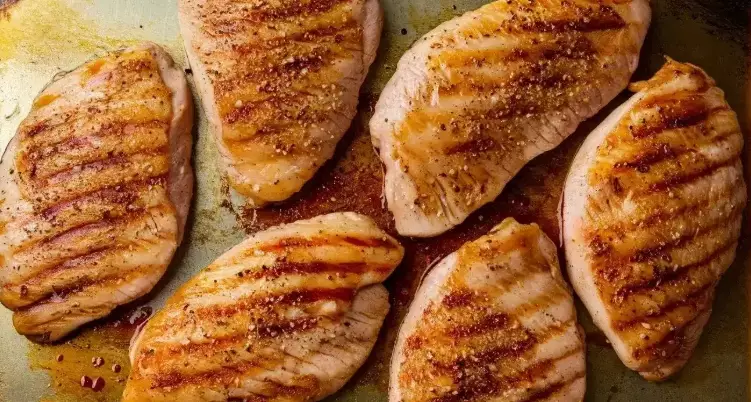
Putting It All Together: My Simple Checklist for Success
- Dry it. Paper towels are your first step.
- Season it. Salt at least 10 minutes ahead if possible, or right before cooking.
- Preheat. Pan or oven, get it properly hot.
- Cook by look & time. Get that golden sear, flip once, start checking temp early.
- Trust the thermometer. 160-162°F in the thickest part, then stop cooking.
- Rest it. 5-7 minutes on a plate. Add butter or juices. Walk away.
- Slice against the grain. See those lines running along the breast? Cut perpendicular to them. It makes the fibers shorter and the meat seem more tender.
Figuring out how long to cook thin chicken breast isn't about memorizing one magic number. It's about understanding that you're working with a delicate, fast-cooking protein. Respect the clock, worship the thermometer, and embrace the rest. Do those three things, and you'll banish dry chicken for good. It turns a source of weeknight anxiety into a reliable, 15-minute path to a delicious dinner. And honestly, isn't that what we're all looking for?
Now go grab that pack of chicken and your timer. You've got this.
Reader Comments